
You’re Overstimulated – But by What?
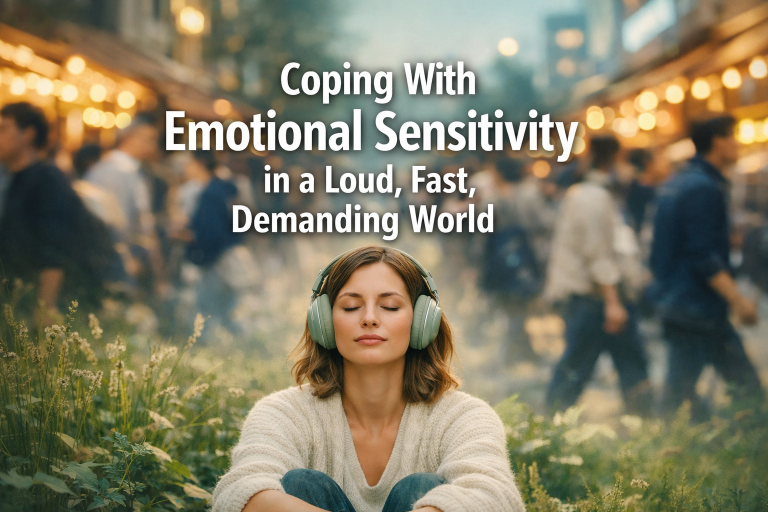
Your phone buzzes. The TV is on. Someone is talking to you. A notification pops up. Your chest feels tight. You think, "I'm just overstimulated." But what does that actually mean?
If you're a highly sensitive person, you've probably said this to yourself a dozen times. The feeling is real. The label? Too vague. Because when you're overstimulated, the cause matters. A lot.
The Problem With Just Saying "Too Much"
Let me tell you why that phrase bothers me.
When everything feels like "too much," you start treating all overload the same. You dim the lights. You cancel plans. You lie in bed. And sometimes that helps. But sometimes you lie there scrolling, still anxious, still wired, still unable to settle.
Why? Because you haven't identified the actual source.
Research on modern life and overstimulation points out that our environments are louder, faster, and more demanding than ever. But "louder and faster" isn't one problem. It's several problems wearing the same coat.
You see, your nervous system takes in information through different channels. And each channel has its own limit. Its own threshold. Its own kind of exhaustion.
When you lump it all together, you miss the chance to give yourself the specific kind of relief you actually need.
The Five Channels of Overstimulation
Let's break this down.
1. Sensory Overload
This is the one most empaths recognize. Loud noise. Bright lights. Crowded stores. Strong smells. Itchy tags. The hum of fluorescent lights.
Your body is taking in physical stimuli faster than it can process them. The world is literally too loud, too bright, too close.
Healthline's guide to signs of overstimulation in adults describes this as irritability, fatigue, restlessness, or the sudden urge to escape. Sound familiar?
2. Cognitive Overload
Too many decisions. Too much information. Too many tabs open, in your browser and in your mind.
This is the channel that gets you when you've been researching something for an hour, or when you're trying to plan a trip, manage a project, and remember to buy groceries all at once.
Your brain hits capacity. Not because you're not smart enough. Because you're processing too much at once.
3. Emotional Overload
Your own feelings. Someone else's feelings. The grief you saw on the news. The tension you picked up from your coworker's silence.
For highly sensitive people, this channel runs hot. You don't just feel your emotions. You absorb others'. And that absorption has a cost.
4. Social Overload
Monitoring reactions. Tracking expectations. Navigating interpersonal tension. Performing. Masking. Being "on."
Social overload isn't about being around people. It's about the work of being around people. The constant reading of cues. The effort to say the right thing. The weight of not disappointing anyone.
5. Processing Overload
Not enough time to digest what happened. A conversation you haven't had time to think about. An event you moved through too fast. A week that never paused.
This channel is sneaky. You might not feel overloaded in the moment. But days later, you're exhausted, irritable, or emotionally raw, and you can't figure out why.
The truth? Your system is still working through last Tuesday.
Why Digital Life Makes Everything Worse
Now let's talk about the elephant in the room.
Your phone. Your feeds. The endless scroll.
Research on digital overstimulation and dopamine patterns shows that algorithmic feeds are designed to hijack your attention system. Every swipe, every autoplay, every notification triggers small dopamine responses that keep you coming back for more.
And it's not just adults. Studies linking high daily social media use to acute mental health risks in teens found that heavy users showed significantly higher rates of anxiety and suicidal ideation. Population-based evidence connects more than two hours of daily social media use to increased depressive symptoms.
But why? What's actually happening?
The 2025 attention economy analysis explains it well: social comparison, constant connectivity, and algorithmic feeds create a loop. You see curated lives. You feel inadequate. You scroll to feel better. You feel worse. Repeat.
And short-form video? Psychology Today's breakdown of short-form content harms notes that rapid-fire clips fragment your attention and make sustained focus feel boring by comparison. Your brain adapts to constant novelty. Then real life feels slow. Flat. Uninteresting.
Some researchers call this "digital anhedonia", a reduced capacity to feel pleasure from ordinary experiences because your reward system has been overstimulated by engineered content.
University Hospitals' piece on "brain rot" and rebuilding focus puts it plainly: endless scrolling doesn't just waste time. It changes how your brain engages with the world.
So when you say you're overstimulated… your phone might be the loudest channel of all.
The Experiment: Identify the Channel
Here's what I want you to try today.
The next time you notice yourself becoming overloaded, resist the urge to simply label it "too much."
Pause. Ask yourself: which channel is producing this?
Then change one variable belonging to that channel.
If the problem is cognitive, turning down the lights probably won't help. You need fewer decisions, fewer inputs, fewer tabs.
If the problem is social, leaving the TV off won't fix it. You need less interpersonal demand. Fewer people to track. Permission to stop performing.
If the problem is sensory, you need quiet, dim light, space, soft textures.
If the problem is emotional, you need to separate what's yours from what isn't. You need to feel without absorbing.
If the problem is processing, you need time. Unstructured, unscheduled, empty time. Just to let your system catch up.
The practical promise: Better discrimination may produce better self-regulation. When you know what's hitting you, you can respond with precision instead of just collapsing.
What to Actually Do
Clinical advice for coping with overstimulation suggests a few reliable strategies. But I want to make them specific to each channel.
For sensory overload: Reduce input. Earplugs. Sunglasses. Step outside. Find a quiet room. Lower the lights. Remove the scratchy sweater.
For cognitive overload: Stop multitasking. Write everything down so your brain doesn't have to hold it. Make one decision at a time. Close the extra tabs.
For emotional overload: Name what you're feeling. Ask: "Is this mine?" If it isn't, visualize setting it down. Step away from the source. Breathe.
For social overload: Stop masking. Say less. Leave early. Tell one trusted person you need quiet. Give yourself permission to be boring for a while.
For processing overload: Create empty time. No agenda. No phone. Just sit. Walk. Stare out a window. Let your mind wander without feeding it more content.
And for digital overload specifically? Mental Health.com's overview of social media effects recommends setting hard limits on screen time, turning off notifications, and creating tech-free windows in your day.
Start small. One variable. One channel. One change.
Finally…
You're not broken because you get overstimulated. Your nervous system is doing exactly what it was built to do, taking in more, feeling more, noticing more. That's not a flaw. It's a design feature.
But living well as a sensitive person means getting specific. "Too much" is a starting point, not an answer. The real question is: too much of what?
When you learn to identify the channel, you stop guessing. You stop applying the wrong fix. You start giving yourself exactly the kind of relief your system needs in that moment.
Try it today. The next time the tightness shows up, the irritability, the urge to flee… pause. Ask which channel is overloaded. Change one thing that belongs to that channel.
That's the whole practice. Not becoming less sensitive. Becoming more precise in how you care for your sensitivity.
You deserve that kind of attention. Especially from yourself.