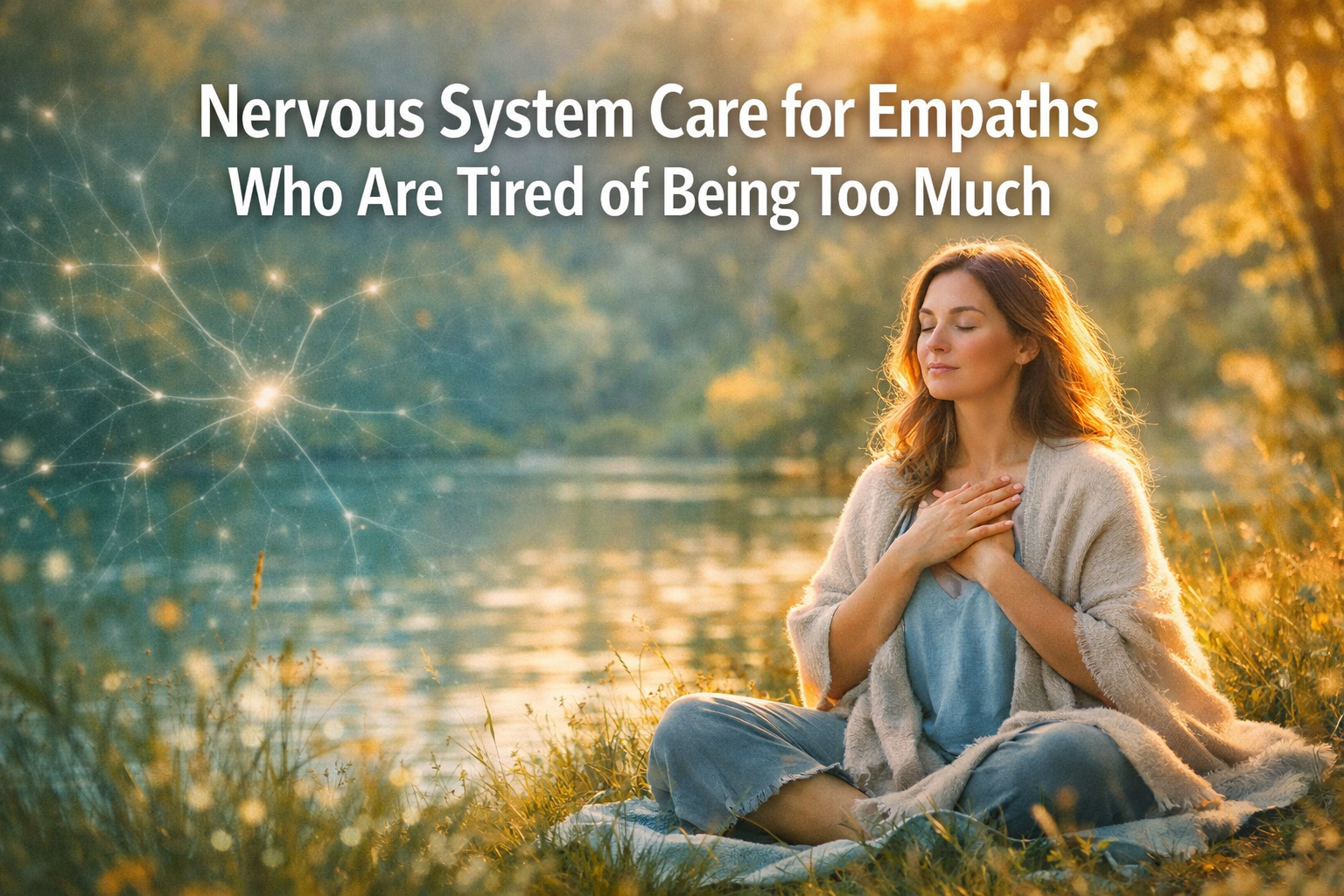
Nervous system care for empaths
Nervous system care for empaths who are tired of being “too much” starts with understanding that your heightened sensitivity is a real neurobiological trait, not a character flaw. The most effective approach combines grounding techniques, breathwork, boundary practices, and self-compassion exercises to regulate your nervous system when you’ve absorbed too much from the world around you. These practices help you move from constant overwhelm to calm presence without losing your empathic gifts.
You know that feeling when someone walks into a room and you immediately sense their mood?
When their anxiety becomes your anxiety. Their sadness settles into your chest. Their anger makes your hands shake.
And then someone tells you you’re “too sensitive.” That you need to “toughen up.”
Maybe you’ve started to believe them.
I’m thinking about all the times I’ve left a coffee shop feeling drained, a family gathering feeling like I’d run a marathon, a simple conversation feeling like I’d carried someone else’s emotional baggage for miles.
The truth? Your nervous system is doing exactly what it’s designed to do. It’s just working overtime.
What Makes Empaths Different at a Nervous System Level?
Empaths have a hyperactive mirror neuron system that places them high on the empathy scale[3]. This means your brain literally mirrors what others are experiencing—not just emotionally, but physically.
When someone near you is stressed, your mirror neurons fire as if you’re experiencing that stress yourself. Your heart rate might increase. Your breathing might quicken. Your muscles might tense.
This isn’t imagination. It’s neurobiology.
Research shows that empaths may experience depression, anxiety, and post-traumatic stress disorder on a deeper level than less sensitive individuals[1]. Your nervous system processes emotional information differently, and it processes more of it.
Here’s what happens in your body:
- Your sympathetic nervous system (fight-or-flight response) activates more easily
- Your parasympathetic nervous system (rest-and-digest response) has a harder time kicking in
- You stay in a state of heightened alert longer than others
- Your body stores emotional tension from experiences that aren’t even yours
Think of it this way: most people have a standard emotional filtration system. Yours is industrial-strength, processing everything at maximum capacity.
And that’s exhausting.
Why Traditional Advice Doesn’t Work for Nervous System Care
“Just don’t take things personally.”
“Learn to let it go.”
“Stop being so emotional.”
Yeah. If only it were that simple.
The problem with most advice is that it treats empathy like a choice. Like you’re deciding to feel everything so deeply.
But your nervous system doesn’t care about willpower. It responds to actual regulation techniques.
Telling an empath to “just relax” is like telling someone with a broken leg to “just walk it off.” The system needs specific support to heal and function properly.
Common mistakes empaths make:
- Trying to suppress feelings instead of processing them
- Avoiding all social situations instead of learning to prepare for them
- Blaming themselves for being “broken” instead of understanding their neurobiology
- Pushing through exhaustion instead of honoring their need for recovery time
You can’t think your way out of nervous system dysregulation. You have to work with your body.
How Do You Know When Your Nervous System Needs Care?
Your body is always sending signals. The question is whether you’re listening.
Physical signs of nervous system overload:
- Chronic fatigue that sleep doesn’t fix
- Digestive issues (your gut is deeply connected to your nervous system)
- Tension headaches or migraines
- Muscle pain, especially in shoulders, neck, and jaw
- Racing heart or chest tightness
- Difficulty sleeping or staying asleep
Emotional and mental signs:
- Feeling overwhelmed by small tasks
- Crying easily or feeling emotionally raw
- Difficulty making decisions
- Brain fog or trouble concentrating
- Irritability or sudden mood shifts
- Feeling like you need to escape or hide
Behavioral signs:
- Withdrawing from people you usually enjoy
- Canceling plans at the last minute
- Reaching for numbing behaviors (scrolling, eating, drinking)
- Difficulty setting or maintaining boundaries
- People-pleasing even when it hurts you
If you’re nodding along to more than a few of these… your nervous system is waving a red flag.
What Are the Most Effective Nervous System Regulation Techniques?
Let me tell you what actually works. Not theory. Not what should work. What does work.
Grounding Practices
Grounding brings you back into your body and the present moment. When you’re absorbing everyone else’s energy, you literally lose connection to yourself.
Simple grounding techniques:
- 5-4-3-2-1 sensory exercise: Name 5 things you see, 4 you can touch, 3 you hear, 2 you smell, 1 you taste
- Barefoot contact: Stand on grass, soil, or even a wooden floor for 5-10 minutes
- Cold water: Splash your face or hold ice cubes to activate your vagus nerve
- Body scan: Slowly bring awareness to each part of your body from toes to head
These aren’t just relaxation tricks. They’re nervous system reset buttons.
Breathwork for Regulation
Your breath is the fastest way to communicate with your nervous system. When you’re overwhelmed, your breathing becomes shallow and rapid.
Try this right now:
Breathe in for 4 counts. Hold for 4. Breathe out for 6. Hold for 2.
Repeat five times.
The longer exhale activates your parasympathetic nervous system—the calm-down response your body desperately needs.
Research shows that mindfulness-based practices, including breathwork, can reduce symptoms of anxiety and increase emotional resilience[1]. For empaths, this creates space between feeling and absorbing.
Somatic Therapy Techniques
Somatic therapy addresses the mind-body connection through body-based interventions including breathwork, touch, and guided movement[1].
Your body holds emotions that your mind hasn’t processed yet. Especially emotions that aren’t even yours.
At-home somatic practices:
- Shaking: Literally shake your body for 2-3 minutes to release stored tension
- Progressive muscle relaxation: Tense and release each muscle group
- Gentle movement: Yoga, stretching, or slow walking with body awareness
- Self-massage: Use your hands or a foam roller on tense areas
When you move stuck energy through your body, you create space for your nervous system to recalibrate.
How Can You Create Boundaries That Actually Protect Your Nervous System?
Boundaries aren’t mean. They’re medicine.
But for empaths, setting boundaries feels like cutting off connection. Like saying “I don’t care about you.”
Let me reframe this: boundaries are how you care for others without destroying yourself in the process.
Energy boundaries to practice:
- Before social situations: Set an intention for how long you’ll stay and what you can give
- During conversations: Notice when you’re absorbing someone’s emotions and mentally step back
- Physical space: Create actual distance when you feel overwhelmed (bathroom breaks are your friend)
- Time boundaries: Schedule alone time after draining interactions
The “not my circus, not my monkeys” practice:
When you notice yourself taking on someone else’s problem, pause. Ask yourself: “Is this mine to carry?”
If it’s not, imagine setting it down. Visualize it. Feel the weight leaving your shoulders.
This isn’t abandoning people. It’s recognizing that you can witness someone’s pain without becoming their pain.
What Role Does Self-Compassion Play in Nervous System Care for Empaths?
Here’s something I wish someone had told me earlier: you can’t heal your nervous system while hating yourself for having one that needs healing.
Compassion-Focused Therapy teaches empaths to develop self-compassion without suppressing their empathy, which can significantly reduce feelings of guilt and shame[1].
Think about how you talk to yourself when you’re overwhelmed.
“I’m too sensitive.”
“I should be able to handle this.”
“Everyone else is fine—what’s wrong with me?”
That’s not helping. That’s adding stress to an already stressed system.
Self-compassion practices for empaths:
- Speak to yourself like a friend: What would you say to someone you love in this situation?
- Acknowledge the difficulty: “This is really hard right now” instead of “I’m failing”
- Normalize your experience: “Many empaths feel this way” instead of “I’m broken”
- Give yourself permission: To rest, to say no, to take up space
Self-compassion isn’t self-indulgence. It’s self-preservation.
How Do You Build a Daily Nervous System Care Routine?
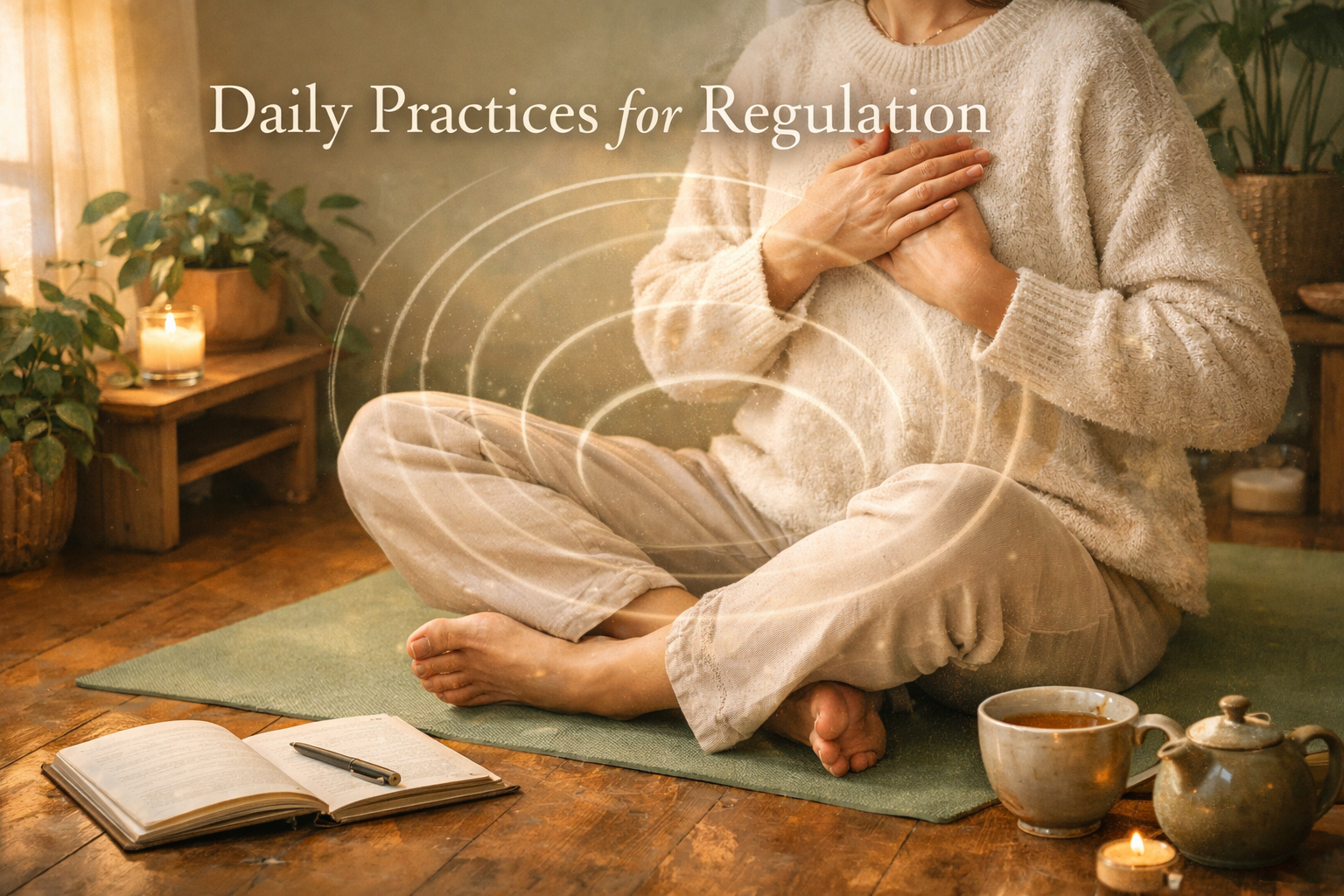
Waiting until you’re in crisis mode doesn’t work. Your nervous system needs consistent, gentle care.
Morning practices (5-10 minutes):
- Gentle stretching or movement
- Breathing exercises before checking your phone
- Setting an intention for your energy that day
- Grounding through bare feet on the floor
Throughout the day:
- Hourly check-ins: “How am I feeling right now?”
- Mini breathing breaks between tasks or interactions
- Physical grounding when you notice absorption happening
- Saying no to one thing that would drain you
Evening practices:
- Journaling to process the day’s emotions
- Somatic release through shaking or stretching
- Creating a calm-down routine (dim lights, gentle music, warm tea)
- Gratitude for moments you stayed regulated
Weekly non-negotiables:
- At least one full day of minimal social interaction
- Time in nature
- Creative expression (writing, art, music—whatever moves energy)
- Body-based practice (yoga, dance, walking)
The goal isn’t perfection. It’s consistency.
Small, regular care prevents big crashes.
When Should You Seek Professional Support?
Sometimes self-care isn’t enough. And that’s okay.
Cognitive Behavioral Therapy is identified as one of the most effective evidence-based approaches for managing the emotional challenges associated with being an empath[1]. CBT helps identify and restructure unhelpful thought patterns that intensify emotional stress.
Consider professional help if:
- You’re experiencing persistent anxiety or depression
- Your relationships are suffering because of emotional overwhelm
- You’re using substances to manage your sensitivity
- You have trauma that’s affecting your nervous system regulation
- Self-care practices aren’t creating meaningful change after several weeks
Therapy isn’t admitting defeat. It’s getting the right tools for your specific nervous system.
Look for therapists trained in:
- Somatic therapy
- EMDR (for trauma processing)
- Mindfulness-Based Stress Reduction
- Compassion-Focused Therapy
You deserve support that understands your neurobiology, not just your symptoms.
Can You Heal Your Nervous System While Staying Empathic?
This is the fear, isn’t it?
That if you protect yourself, you’ll lose your gift. That regulation means shutting down. That boundaries mean becoming cold.
I’m thinking about this a lot lately…
And here’s what I’ve learned: a regulated nervous system actually makes you a better empath.
When you’re not drowning in overwhelm, you can actually be present with others. You can feel their emotions without losing yourself in them. You can offer genuine support instead of anxious people-pleasing.
What changes with nervous system care:
- You still feel deeply—but you don’t get stuck in those feelings
- You still sense others’ emotions—but you recognize them as separate from yours
- You still care—but you don’t carry what isn’t yours
- You still connect—but you don’t disappear in the process
The goal isn’t to feel less. It’s to feel with more awareness and choice.
Your sensitivity is a strength. But like any strength, it needs proper care to function well.
Frequently Asked Questions
How long does it take to regulate an overwhelmed nervous system?
Immediate relief can happen within minutes using grounding or breathing techniques. Long-term nervous system healing typically takes 6-12 weeks of consistent daily practice. Your nervous system didn’t become dysregulated overnight, and it won’t fully heal overnight either. Small improvements often appear within the first week.
Can empaths ever feel “normal” in social situations?
Empaths can feel comfortable and energized in social situations with the right preparation and boundaries. This includes choosing smaller gatherings, planning recovery time afterward, using grounding techniques during events, and leaving when your body signals it’s time. “Normal” for you will look different than for non-empaths, and that’s perfectly fine.
What’s the difference between being an empath and having anxiety?
Empaths experience heightened emotional sensitivity due to their mirror neuron system, while anxiety is a mental health condition involving persistent worry and fear. Many empaths develop anxiety because of chronic nervous system dysregulation, but not all anxious people are empaths. The two can coexist and both deserve specific care.
Do I need to avoid people to protect my nervous system?
No. Complete isolation isn’t healthy or necessary. Instead, learn to prepare for interactions, set time limits, choose environments wisely, and schedule recovery periods. Quality connections with understanding people can actually support nervous system health. The key is intentionality, not avoidance.
Why do I feel drained after helping someone even when I want to help?
Your nervous system absorbs and processes their emotional state along with your own response to their situation. This double load depletes your energy reserves quickly. You can still help others while protecting your nervous system by maintaining awareness of what’s yours versus theirs and using grounding techniques during and after supportive conversations.
Is being an empath a mental health condition?
No. Being an empath is a personality trait and neurobiological difference, not a mental health disorder. That said, empaths may be more susceptible to mental health challenges like anxiety and depression due to nervous system strain[1]. Your empathy itself isn’t a problem—it’s the lack of proper nervous system care that creates issues.
Can medication help with empath overwhelm?
Medication can help manage anxiety or depression symptoms that result from chronic nervous system dysregulation. Some empaths find that treating underlying mental health conditions makes nervous system regulation easier. Medication works best when combined with therapy and nervous system care practices, not as a replacement for them.
What should I do when I’ve absorbed someone’s bad mood?
First, recognize it’s not yours—name it out loud if needed (“This is their anger, not mine”). Then use a physical reset: shake your body, wash your hands, step outside, or do breathing exercises. Creating physical and mental separation helps your nervous system distinguish between their emotional state and yours.
How do I explain my needs to people who don’t understand empaths?
Skip the label if it creates resistance. Instead, use concrete language: “I need quiet time to recharge,” “I process emotions deeply and need space afterward,” or “Large groups drain my energy.” Focus on your specific needs rather than defending your identity as an empath.
Can children be empaths, and do they need different nervous system care?
Yes, children can be highly sensitive and empathic. They need age-appropriate versions of the same practices: simple breathing exercises, physical play for energy release, clear routines, safe spaces to retreat, and validation of their feelings. Teaching nervous system care early helps them develop healthy coping patterns.
Will I always need to actively manage my nervous system?
Nervous system care becomes more automatic with practice, like brushing your teeth. You’ll always have heightened sensitivity, but the active effort decreases as regulation becomes habit. Many empaths find that after months of consistent practice, their baseline regulation improves significantly and maintenance requires less conscious effort.
What’s the fastest way to calm down when I’m overwhelmed in public?
Use the “ice dive” response: splash cold water on your face or hold ice in your hands. This activates your vagus nerve and triggers an immediate calming response. If water isn’t available, press your thumb firmly into the center of your opposite palm while taking slow, deep breaths. Both techniques work within 60-90 seconds.
Key Takeaways
- Your empathic sensitivity is rooted in a hyperactive mirror neuron system—a real neurobiological difference that requires specific care
- Nervous system dysregulation shows up physically (fatigue, tension, digestive issues), emotionally (overwhelm, mood swings), and behaviorally (withdrawal, people-pleasing)
- Grounding techniques, breathwork, and somatic practices provide immediate relief and long-term healing when practiced consistently
- Boundaries protect your nervous system without diminishing your capacity for genuine connection and empathy
- Self-compassion is essential—you can’t heal while criticizing yourself for needing healing
- Daily nervous system care prevents crisis-level overwhelm and builds lasting resilience
- Professional support through CBT, somatic therapy, or mindfulness-based approaches can accelerate healing for empaths with persistent challenges
- Regulation doesn’t mean feeling less—it means feeling with awareness, choice, and the ability to return to center
- Small, consistent practices create more change than occasional intensive efforts
- You can be both sensitive and strong, empathic and boundaried, open-hearted and self-protected
Conclusion
You’re not too much.
You never were.
Your nervous system is doing exactly what it’s designed to do—it’s just doing it at a higher intensity than most people experience. And that intensity needs care, not criticism.
The practices in this article aren’t about fixing you. They’re about supporting the beautiful, complex nervous system you have so it can function without burning you out.
Start small. Maybe it’s just three deep breaths before you walk into a room full of people. Maybe it’s five minutes of barefoot grounding each morning. Maybe it’s finally saying “I need to leave early” without apologizing.
Your nervous system will respond to gentle, consistent care. It wants to find balance. It wants to help you feel deeply without drowning.
And here’s what I want you to remember on the hard days: your sensitivity isn’t a burden the world has to tolerate. It’s a gift that deserves protection.
Take care of your nervous system. It’s the only one you have.
And it’s been working so hard to help you navigate a world that doesn’t always understand what it’s like to feel everything.
You’ve got this. One breath, one boundary, one moment of self-compassion at a time.
References
[1] Therapy For Empaths Highly Sensitive Person Treatment Options – https://www.mentalhealth.com/library/therapy-for-empaths-highly-sensitive-person-treatment-options
[3] Empaths Compassion Mirror Neurons – https://drjudithorloff.com/empaths-compassion-mirror-neurons/